Most boat owners don’t notice sediment buildup until the boat hits bottom or gets stuck. Dragging bottom on the way out can even prevent your boat lift from lowering all the way. By then, the water is too shallow, and getting in and out of the slip becomes a guessing game. Choosing the right fix, whether mechanical vs. hydraulic dredging, depends on your slip’s sediment type and size. Understanding how each method works helps you remove the buildup, restore safe depth, and protect your boat before the problem gets worse.
Dredging operations address this issue effectively. The process eliminates accumulated sediment, reinstating navigable depth and secure access to the boat. Two primary methodologies exist: mechanical and hydraulic approaches.
When you need to remove mud, sand, or debris from the bottom of a body of water, dredging is the answer. Excavation beneath the water surface requires a method suited to the site’s specific requirements. Neither mechanical nor hydraulic dredging is best for every situation; each works better under different conditions and project requirements.
How Sediment Ends Up Where Your Boat Needs to Be
Sediment settles where water slows down. That means canal bottoms, the area around docks and pilings, the space under a boat lift, marina fairways, and pond floors. It builds slowly, so it’s easy to miss.
A few signs it’s time to check your depth:
- Your hull touches bottom at low tide
- Your boat lift can’t lower all the way
- Boats that used to come and go freely now have to wait for high water
What Is Mechanical Dredging?
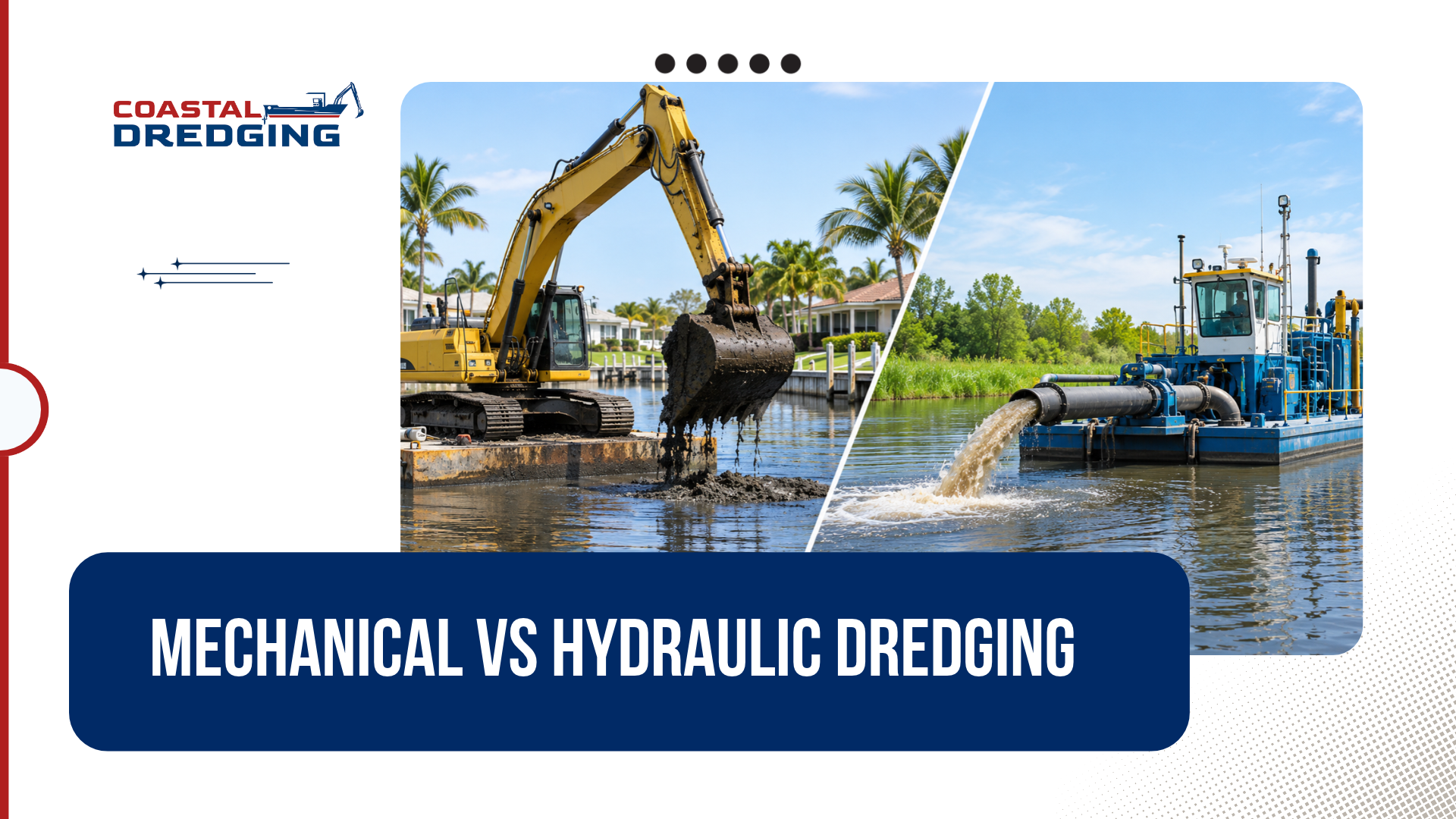
Mechanical dredging removes considerable underwater material deposits, including sand, gravel, and compacted sediment. Operators deploy a long-reach excavator or a crane with a clamshell bucket to extract bottom sediments and lift them from the water. This approach excels in applications requiring precision, such as maritime dock structures, marina facilities, and narrow canals.
The machines can shift tough materials and allow the owner to see what is being removed and where it is being dumped.
Mechanical Dredging is time consuming, as the process involves back and forth of evacuation and dumping. This also requires space, where the needed equipment can be placed close to the dredging area.
What Is Hydraulic Dredging?
Hydraulic dredging operates through suction mechanisms, extracting a slurry of sediment and water via a suction pipe. A pump extracts a combination of sediment and water, referred to as slurry, via a suction pipe. Many hydraulic dredges have a spinning cutterhead on the end that loosens the bottom so it can be drawn in. The slurry then moves through a pipeline to a containment or dewatering area, where the sediment settles out.
Hydraulic dredging is suited for loose or semi-loose sediment, such as fine silt and sand. It is also effective for large areas where removal is continuous.
Pumping moves a lot of water, so you need room for containment or dewatering bags. You also need a plan for the return water, including space and a plan for handling it.
Mechanical vs Hydraulic Dredging: Side by Side
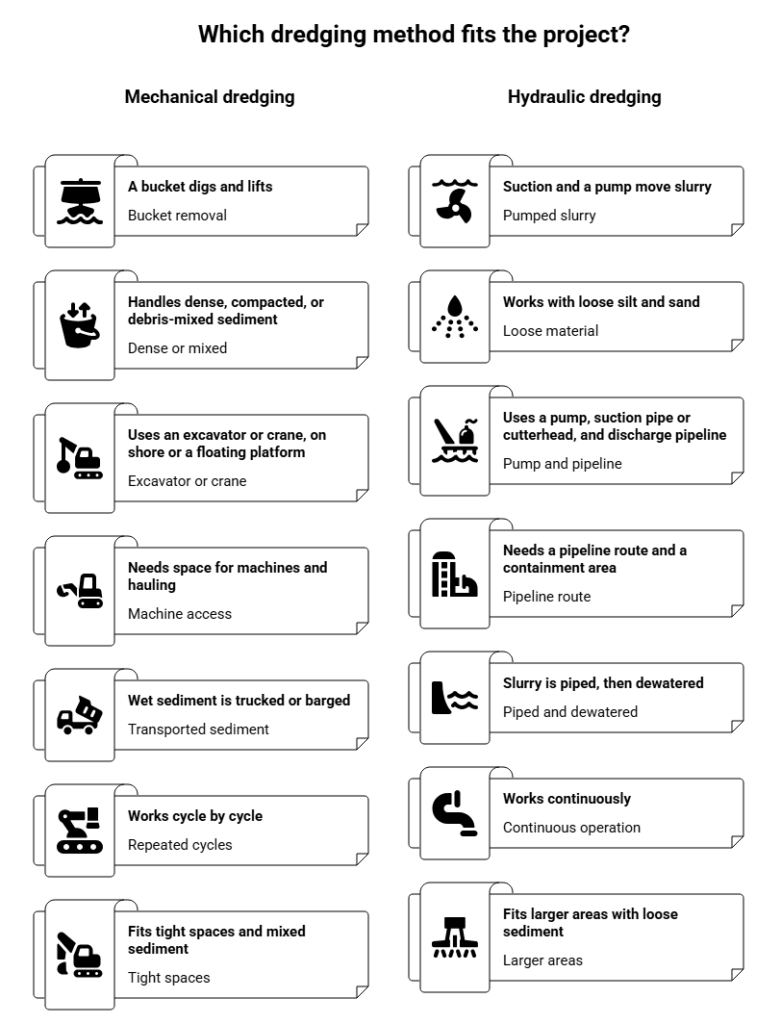
Projects often fall between categories, and some blend both. Use the table as a starting point for discussing your site.
How the Job Changes From One Property to the Next
A canal, a slip, and a pond all lose depth, but in different ways.
Canals: They run long and are often shared. Sediment builds up in areas with slow water movement. Barriers like seawalls, bridges, and overhead lines can restrict access, and housing associations must agree on scope and cost before canal dredging starts.
Boat slips and docks: The main requirement is space. Crews work around pilings, moored boats, and tight clearances, so precision matters more than speed. Tight-space work and custom-fabricated equipment prove their worth here. See our dock dredging service, or read how boat slip depth is measured.
Boat lifts: Boat lifts require clear water under the cradle to raise and lower a boat. The work area is small and sits right next to the frame, so crews have to be careful around the structure. Learn more about boat lift dredging.
Marinas: There are many slips, fairways, and channels, and boats still need to move. Volumes are bigger, and the plan for staging and handling sediment has to fit around daily operations. More on marina dredging.
Ponds: Freshwater ponds and lakes often collect fine, organic sediment over many years. Vehicle access can be limited, and the plan for the removed material and water may look different from a tidal canal. See our freshwater dredging service and an article on lake and pond dredging costs for Florida HOAs.
So, What Is a Dredge Boat?
People hear “dredge boat” and picture one specific machine. It’s really a general term for a floating work platform that carries dredging equipment. That could be a barge or pontoon with a crane or excavator on it, or a vessel with a pump and suction system.
The platform lets crews work over the water where a machine on shore can’t reach. Many use spuds, which are long posts that drop to the bottom and hold the platform in place. Support barges often work alongside to carry away the removed sediment.
A dredge boat can help when the work area is out of reach from shore, when there’s no land access to a canal, marina, or pond, or when a long canal run is easier to work from the water.
The platform has to fit the canal’s width and depth of the site, and a crane on a barge has to stay stable while it swings a load. Some sectional platforms can be trucked in and put together on site, which helps in narrow canals. On a lot of residential jobs, work from land covers it and a dredge boat isn’t needed.
What Happens to the Sediment After It’s Removed
Taking sediment out is only half the job. It has to go somewhere, and the plan depends on the method.
With mechanical dredging, crews usually load wet sediment into trucks or barges, or set it in a staging area to drain first. With hydraulic dredging, crews pump the slurry to a containment area where the sediment settles, and they handle the water separately.
Either way, the site needs room to work. A tight lot with no staging area may point toward one method over the other. Where the material can go, and what rules apply, can change with location and sediment type. Sort that out during planning, not after the work starts.
How to Choose Between Mechanical vs Hydraulic Dredging
Start with a few questions:
- What is the sediment made of? Loose silt, sand, packed shell , and debris all behave differently. Probing and sampling give you a clearer picture.
- How much depth do you need? The depth your boat, lift, or slip needs sets the scope.
- How will crews and equipment get in? Look at shore access, bridges, overhead lines, and water access.
- How big is the project? One boat lift and a full marina call for different setups.
- Where does the removed sediment go? Hauling, containment, and dewatering all need space and a plan.
- What approvals apply? Dredging in Florida often involves state, federal, and local review. The Florida Department of Environmental Protection and the U.S. Army Corps of Engineers are commonly involved, and local rules can apply in Palm Beach and Broward counties.
A site visit usually answers most of these. Someone can probe the bottom, check access, measure the depth you have now, and compare it to the depth you need. It also helps to have your boat’s draft and your lift’s specs handy, since they set the target depth.
Requirements vary by site, so look into yours early. Coastal Dredging guides customers through their options and refers them to trusted permitting companies.
Next Step
If your boat is dragging bottom, your lift is short on depth, or low tide leaves you stuck, the best first move is a site review. Our crews are highly trained and use custom-fabricated equipment, which helps in tight spaces around docks, slips, and lifts.
Call Coastal Dredging at 561-905-1122 or book a free consultation. We’ll talk through your sediment, your target depth, and which approach makes sense for restoring safe boat access at your property. Coastal Dredging serves homeowners, HOAs, and marinas across Palm Beach and Broward counties.
References
- https://digitaledition.marineconstructionmagazine.com/mcmag-issue-iv-2019/page-77
- https://www.florida-stormwater.org/assets/MemberServices/Seminars/2020/PDF5_Lance%20Lumbard.pdf
- https://lauderdalebythesea-fl.gov/519/Canal-Dredging