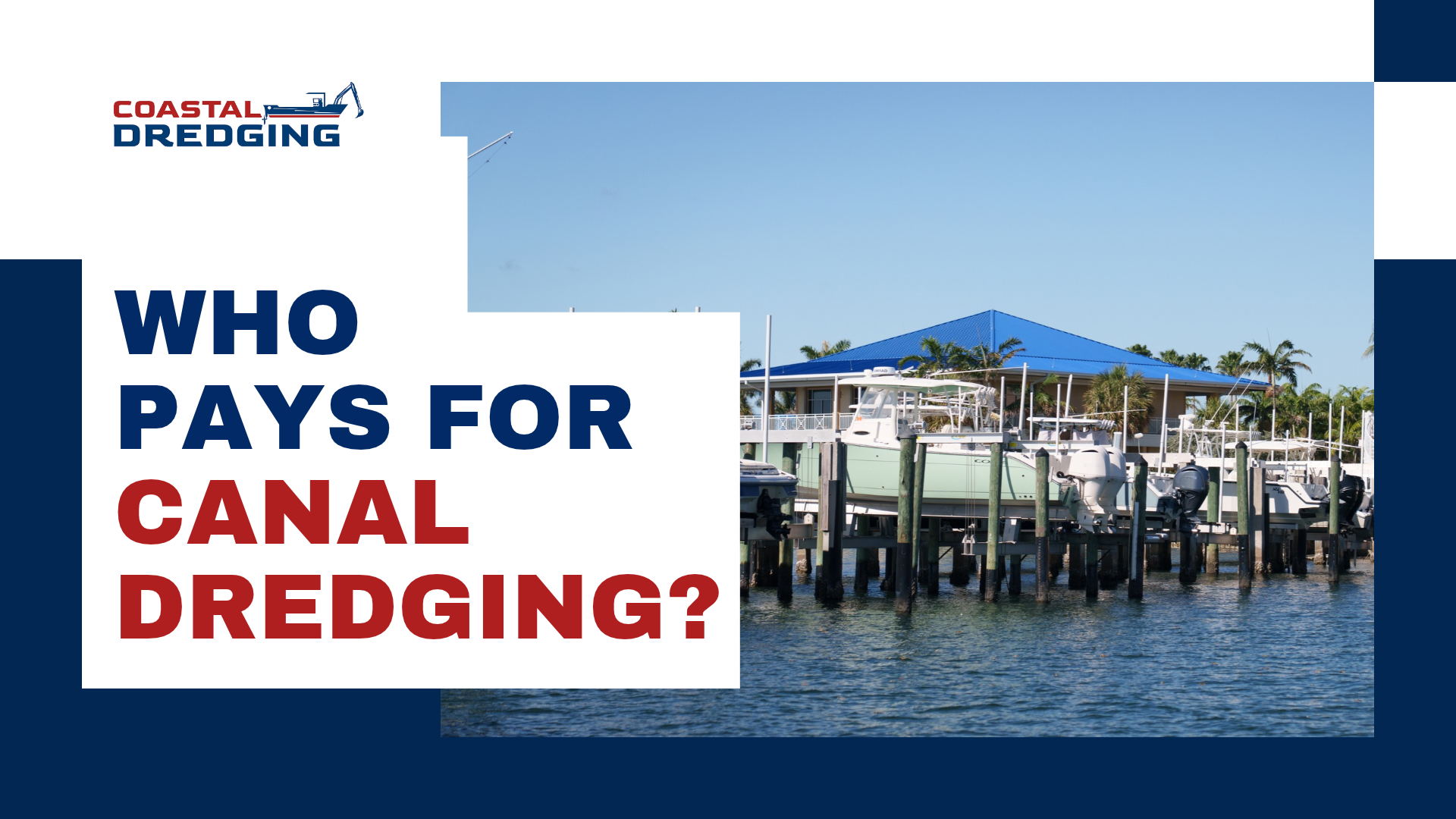
The city probably isn’t coming to dredge your canal if your boat drags the bottom or gets stuck at low tide. If you are wondering who pays for canal dredging in Palm Beach and Broward, then in most residential canals the waterfront owner pays. The cost usually falls on the people who live along the water, whether they pay individually, through an HOA, or by splitting it with neighbors.
In this article, we will explain how to tell where your canal stands under Florida rules and how to get back the usable depth you need to safely access your boat.
Who Pays Depends on Who Owns the Canal
The canal owner, or whoever pays for maintenance, pays to dredge it. But in Florida, that answer isn’t always obvious.
The state holds title to the submerged land beneath navigable waters. But the water body generally had to be navigable when Florida became a state in 1845 to count as sovereign land.
Many South Florida canals were dug out of dry land during development, so their bottoms may belong to private owners or have been dedicated on a subdivision plat.
Maintenance also follows a similar pattern. South Florida’s flood control runs on a three-tier system. One is neighborhood drainage, operated by property owners or associations; next are secondary systems run by drainage districts, counties, or cities; and above them is the primary system.
Cities sometimes also do canal dredging. Even within one city, responsibility can vary. For instance, in Coconut Creek, HOAs maintain most waterways in some communities, while other canals are publicly owned.
Here’s a list of types of waterways and who usually pays for them:
| Type of waterway | Who usually pays |
|---|---|
| Regional flood-control or drainage canal | Water management or drainage district |
| Public navigation channel (such as the Intracoastal) | State and federal agencies |
| City-owned residential canal | The city, if the canal is in its maintenance program |
| HOA or condo canal, basin, or pond | The association |
| Marina basin | The marina owner or operator |
| Private residential canal with no HOA | Waterfront owners, individually or as a group |
In case your canal isn’t on a city or district maintenance list, expect the cost to fall on the property owners.
Why the City or County Usually Doesn’t Pay
Waterfront owners often misunderstand that if their canal opens onto the Intracoastal or a river, it becomes a public canal and the government agency’s responsibility to keep dredged.
In southeastern Palm Beach County, the Lake Worth Drainage District funds its canal systems through an assessment that every property owner in its boundary pays at the same rate, whether they live on a canal or miles away. Their core responsibility is flood control.
The district points out that a canal can be well maintained for flood control. A canal can move stormwater and still be shallow for your boat. Restoring usable depth for boating in most residential canals isn’t a government responsibility.
Where Canal Ownership is Recorded
Canal ownership and maintenance responsibility are usually documented in public records. In Palm Beach County, the Property Appraiser’s PAPA system lists parcel details, and the legal description often includes the subdivision’s plat book and page.
In Broward, the Property Appraiser’s Maps & Aerials tool shows who owns a waterbody. The recorded plat shows whether a canal was dedicated to the public, an HOA, or private owners, and some deeds describe ownership extending to the canal’s centerline.
Your city’s public works department or local drainage district can confirm whether it maintains the canal. Ownership questions in older neighborhoods can get complicated, so a Florida real estate attorney or title company is the best source for a definitive answer.
HOA and Condo Communities: Who Pays and How Coastal Dredging Helps
In a managed community, the association usually pays when the waterway is a common area or common element.
Start With Your Governing Documents
Look for the CC&Rs, declaration of condominium, and recorded plat. If the canal, basin, or pond is listed as a common area (HOA) or common element (condo), the association typically pays for dredging, and all owners share the cost through the budget.
Under Florida’s Condominium Act, the association maintains the common elements, but the declaration can make owners responsible for limited common elements they use exclusively. In some communities, the association maintains the main waterway, while each owner maintains the area around their own dock or boat lift.
Community Ponds Count Too
Stormwater ponds and lakes inside a community are usually the association’s responsibility.
In Palm Beach and Broward, the South Florida Water Management District permits most stormwater systems. Once the developer finishes building a community’s stormwater system, the association usually assumes responsibility for operation and maintenance.
The Lake Worth Drainage District states that the association is solely responsible for drainage infrastructure inside a community, including stormwater ponds. Every neighborhood owner shares that cost, even those who don’t live on a pond.
Governing documents like South Florida Water Management District guidelines check whether association documents allow the association to fund stormwater system operation, maintenance, and replacement through regular and special assessments.
In Broward County, a professional engineer must also inspect drainage systems under the county’s 5-year Surface Water Management License. As sediment builds up, a pond loses depth and holds less stormwater, making pond maintenance both a drainage and a cosmetic concern.
Reserves vs. Special Assessments
Dredging only comes up every several years, so it’s easy to leave out of the annual budget. When the waterway becomes too shallow, the association uses money from reserves it set aside in advance, or charges a special assessment to owners.
HOAs: Florida doesn’t require every HOA to keep reserves. An HOA is considered to have reserve accounts only after a majority of its total voting interests approves them. Associations without reserves must disclose in their budgets that the lack of reserves may lead to special assessments for capital expenditures and deferred maintenance.
Condos: Condo budgets must include reserves for roof replacement, painting, and paving, plus any other item with a deferred maintenance or replacement cost over $25,000, a threshold raised from $10,000 in 2025. Boards that maintain a canal, basin, or pond should ask their community association manager or attorney whether that waterway belongs in the reserve schedule.
How Coastal Dredging Helps Boards Plan the Cost
The board first needs a reliable number to decide whether the funds will come from reserves or a special assessment. Our site assessment and estimate give boards that number before they decide how to fund the project. After the initial consultation and site assessment, we also provide accurate time estimates to help boards plan when the work will happen and when owners will be affected.
Planning ahead also helps keep costs predictable. How often a waterway needs dredging depends on how fast sediment builds up, so we recommend regular assessments to determine when dredging is necessary. For associations, that makes dredging easier to plan as an expected expense rather than an emergency assessment after boats are already stuck at low tide.
Marinas, Boat Slips, and Private Docks
Marina basins, boat slips, and the water around private docks and boat lifts also become shallow over time. Who pays depends on who owns the facility and what the governing documents say.
Commercial Marinas
In a commercial marina, the owner or operator usually pays to keep the basin and slips deep enough for boats to dock and leave safely. A slip that’s too shallow can’t be rented.
Many Florida marinas also sit partly over state-owned submerged land, and the Florida Department of Environmental Protection manages the state’s submerged land leasing program for those facilities. State rules treat maintenance dredging of existing channels and basins differently from dredging that creates new or deeper access.
You can check out our marina dredging services that cover anything from a single slip to an entire marina, and we handle everything from permitting to sediment removal.
Condo Marinas and Owned Slips
In condo marinas, the declaration of condominium usually decides who pays. The association maintains the common elements, but the declaration can assign maintenance of limited common elements to the owner. They can have the association do the work and charge only the owners who use them.
Boat slips are often set up this way. In one Florida case, a condominium’s declaration expressly designated its boat slips as limited common elements. If the declaration doesn’t say otherwise, the association maintains limited common elements as a common expense, and all owners share the cost. Two condo marinas that look the same can split dredging costs very differently.
Private Docks and Boat Lifts
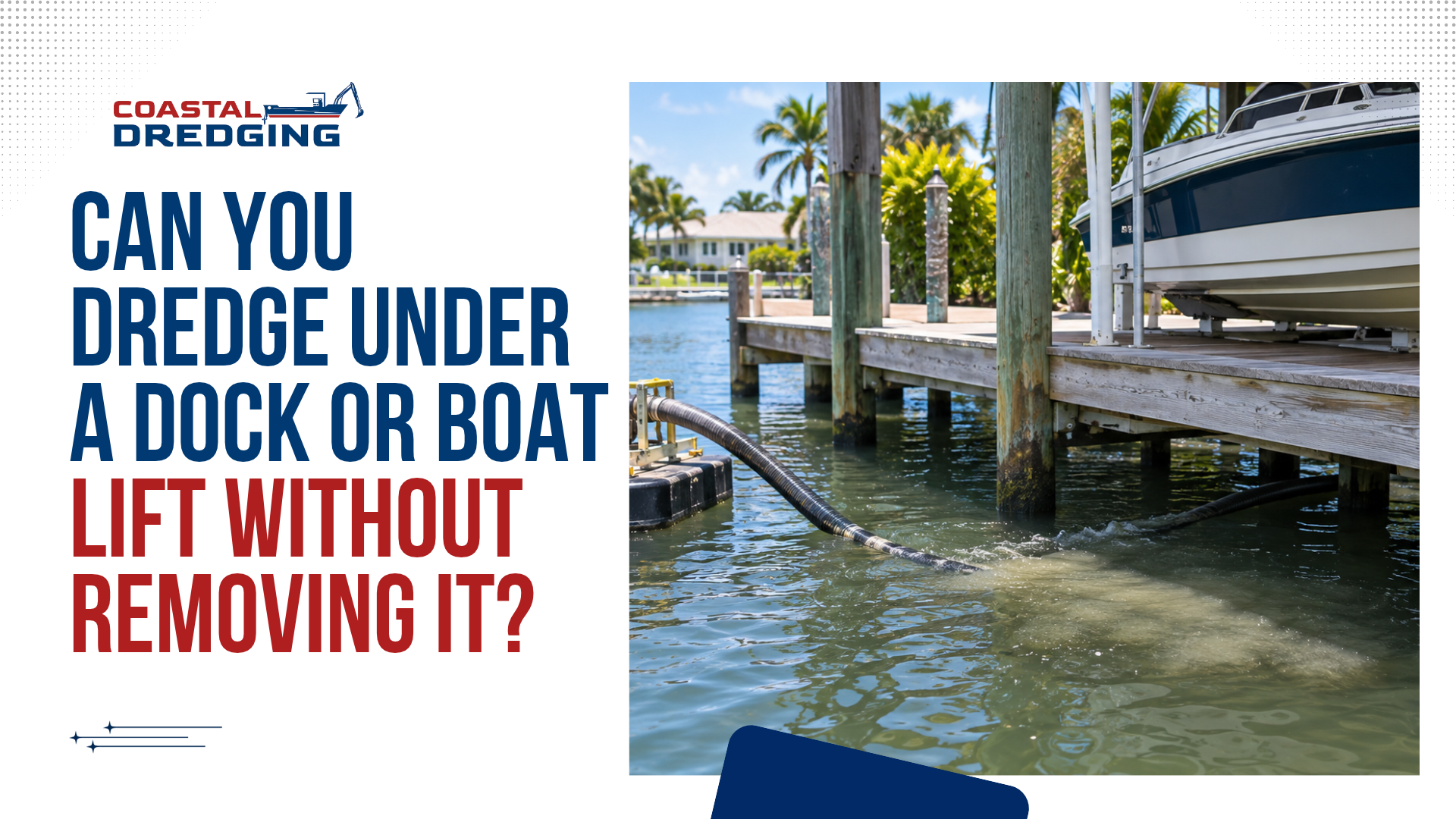
For a single-family home on a private canal, you usually pay to keep the area around your dock or boat lift deep enough.
If your boat drags bottom at the dock or your lift can’t lower the boat fully at low tide, you typically pay for that.
Dredging around one dock only restores depth in that spot. If the canal entrance or the stretch between your dock and open water is also shallow, you may still get stuck at low tide on the way out. That’s when neighbors or the HOA often share the cost of a larger project.
Coastal Dredging offers dock dredging and boat lift dredging for private homes and marinas, plus freshwater dock and boat lift dredging for properties on freshwater.
If There’s No HOA? How Neighbors Split the Cost
The waterfront owners along the canal pay, either through private agreement or, in some counties, a special assessment district.
The Shared Inlet Problem
When the canal mouth or dead-end section silts up, every owner along the canal loses safe boat access, but no one is automatically responsible for fixing it. The owner at the back of the canal often feels it most as the boat has to pass through every shallow spot on the way out.
How Cost-Sharing Usually Works
Neighbors commonly divide the cost in one of three ways:
- Equal shares per waterfront lot
- Shares based on linear feet of frontage
- Shares based on benefit, with owners farther back paying more for the access they gain
These agreements are voluntary, so they work best when owners agree on one scope of work for the whole canal and put the split in writing.
Special Assessment Districts (MSBUs and MSTUs)
Some Florida counties offer a municipal service benefit unit, or MSBU. The county creates a district where only the properties that benefit pay for the project through a non-ad valorem assessment on their annual tax bill.
Unlike a voluntary agreement, an MSBU applies to every benefited property once it’s created. In one Seminole County project, the county filed assessment liens against all the benefited properties, with a final assessment of $3,665 per waterfront property.
MSBUs are more established on Florida’s Gulf Coast and in the Keys than in Palm Beach or Broward. At Coastal Dredging, one site assessment and estimate for the whole canal gives neighbors a single number to divide.
What Affects Each Owner’s Share
The total project cost and each owner’s share of it depend on a few factors:
- Canal Length and sediment buildup: A longer canal or deeper buildup means more material to remove.
- Target Depth: The depth needed for safe boat access determines how much sediment must be removed.
- Equipment access: Whether equipment can work from land or needs to work from the water affects the approach.
- Permits: Projects can need approvals from the U.S. Army Corps of Engineers, the Florida Department of Environmental Protection, and the county. Florida law can exempt maintenance dredging of existing man-made canals from some state permits when the work only restores the canal’s original design depth and meets set conditions.
- Sediment handling and disposal: Canal sediment can contain metals such as arsenic and copper from treated dock pilings and boat bottom paint, which affects how the material is tested and disposed of.
Restore Usable Depth Before It Gets Worse
If your boat is dragging bottom or getting stuck at low tide, contact Coastal Dredging for a free consultation and site assessment. We’ll help you understand what it will take to restore usable depth and safe boat access.
We evaluate your waterfront property to determine what dredging it needs. After the assessment, you get a cost estimate and a time estimate you can share with neighbors, your board, or your marina team.
We handle the necessary permits and make sure the work complies with Florida’s environmental regulations. Also remove sediment buildup to restore water depth around canals, docks, boat lifts, single slips, and entire marinas.
We dispose of the sediment responsibly and leave the site clean and ready to use. See our full list of dredging services.