How long a lake or pond dredging operation takes will depend entirely on the amount of time required for planning, approvals, setup, sediment drying or hauling and the subsequent cleanup. All of that can easily extend the total time well beyond the days and weeks that the dredge is actually working.
Two ponds of the same surface area can have very different schedules as acreage doesn’t tell you anything about how the material is sitting on the bottom. Sediment volume is the key factor in a dredging job.
In this article, we look at the five stages of pond dredging, what dictates the speed of the work, what you can expect during the process, and who to get in touch with.
The Five Stages of a Pond Dredging
Most projects move through five stages. Some overlap. Sediment handling often runs alongside dredging:
| Project stage | What residents might notice | What affects its duration |
|---|---|---|
| 1. Planning and approvals | Survey crews taking depth readings, board discussions, project notices; little visible work | Survey and testing needs, scope, required approvals, budget approval, contractor scheduling |
| 2. Mobilization | Equipment deliveries, fencing, erosion controls, staging areas, and on some projects, pipe laid along the shore | Site access, staging space, protection for lawns and landscaping, equipment type |
| 3. Active dredging | Equipment working on or beside the water during set hours, engine and pump noise, cloudier water | Sediment volume and depth, sediment type and debris, method, working hours, weather |
| 4. Sediment handling | Dewatering bags or drying piles; truck trips if material leaves the site | Drying space, sediment characteristics, testing results, disposal or reuse plan |
| 5. Demobilization and restoration | Equipment and bags removed, regrading, sod or seeding, fences moved, paths reopened | Size of disturbed areas, drying progress, season, closeout requirements |
Stage 1: Planning and Approvals
This is the longest stage, which involves the assessment, sediment survey, scope, any required testing, budget approval, and scheduling. This stage would typically involve:
- Sediment survey: The crew takes water and sediment depths across the pond so the board knows how much to take out. The board will also be doing regular depth checks to inform their plan going forward.
- Scope and method: The target depth, the areas to be included, how the equipment will get to the water, and where the sediment will go.
- Sediment testing: The results will determine where the removed material is permitted to go.
- Budget and board approval: Boards will normally look at the scope and cost prior to scheduling.
- Approvals and scheduling: Permits are often one of the most time consuming elements of a dredging project.
Many of the community lakes in Palm Beach and Broward County are part of a permitted surface water management system and the association will often operate and maintain that system.
The Florida Department of Environmental Protection (FDEP) has a process to determine whether maintenance dredging is eligible for an exemption and the conditions that would apply.
A private pond is not automatically excluded and an ornamental pond may be dealt with differently to a permitted stormwater lake or retention pond. Our look at Florida dredging permit requirements covers the state’s Environmental Resource Permit Program.
Stage 2: Mobilization
During this phase, the crews will be delivering equipment, establishing access, laying protective mats over lawns, installing fencing, erosion controls and staging areas. On some hydraulic projects, they will also lay a temporary pipeline from the pond to the dewatering area.
Narrow roads, landscaping, and retaining walls can all make access difficult. Staging requires open ground adjacent to the water, so you first need a path, a parking area or a common lawn nearby.
Stage 3: Active Dredging
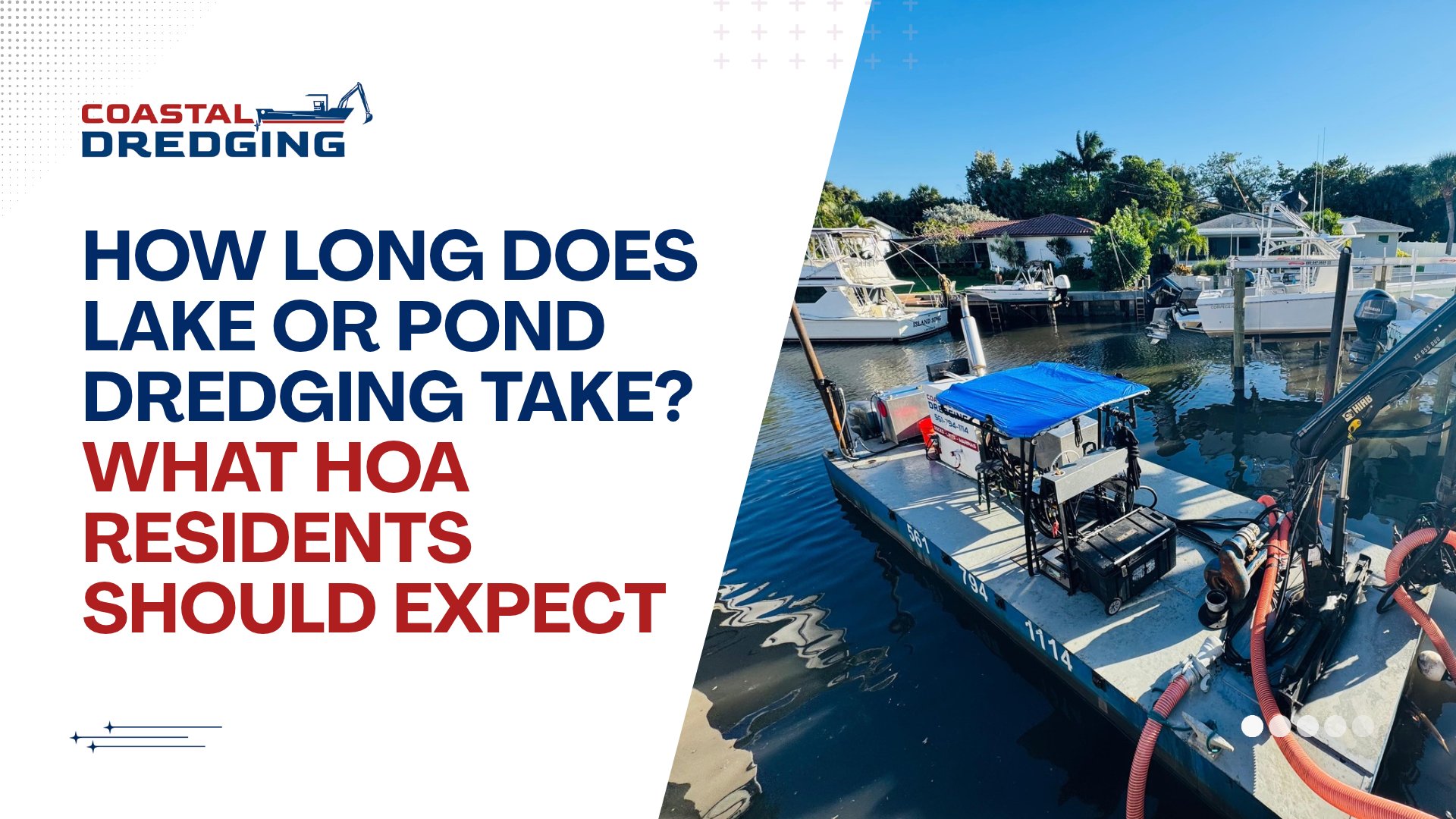
Mechanical dredging involves the use of an excavator to lift the sediment from the bank. Hydraulic dredging involves the use of a floating dredge which pumps the sediment (mixed with water) through a pipeline to a holding or dewatering area. For confined sites, our freshwater dredging crews use purpose-built equipment.
At this stage, people are asking how long the dredging will take. In the various community projects that we’ve had on record, it’s ranged from two weeks to eight weeks. The timescale for the pond will obviously be dependent on the amount of sediment, how difficult the material is to get out, the type of equipment we’re using, and how many hours we work per day.
Debris, roots and the compacted layers will slow either method.
Residents will typically be aware of the equipment being on or adjacent to the water during the set hours, the engine and pump noise and the water being cloudier. Our dredging day article goes into some detail as to why cloudy water doesn’t necessarily mean that there’s a problem and what you can expect during a pond dredge.
Stage 4: Sediment Handling
Dredged material is full of water and generally needs to drain or dry prior to being hauled off, reused or placed on site (where permitted). Hydraulic pumps will typically pump the wet material in a staging area to drain.
Material disposal is going to be a function of testing and available space. It can be hauled off site or it can remain on the HOA property if the site conditions and the permits allow. Off-site hauling will generally involve a truck trip once the material is dry enough to load.
Stage 5: Demobilization and restoration
Demobilization begins once removal and drying have progressed far enough. The crews then go about removing the equipment, the pipeline, the bags and the staging materials and subsequently repair the lawns, irrigation, and shoreline areas that have been disturbed by the work.
Shared areas tend to re-open zone by zone, so a path may well re-open prior to the lawn where the bags were. Some projects will also have a closeout phase, which may involve final documentation for example,; our overview covers what happens before, during and after the dredging.
If your board is looking at lake dredging in Palm Beach County or Broward County, we can go through each of those stages for your site during a consultation.
What Determines the Pace of Work
- It means more material and more working days.
- Sediment types (muck, sand, clay, roots, trash etc.) all behave in a different way.
- Each method requires a different setup and a different amount of staging space.
- A small drying area will of course, slow down the dredging.
- Testing, truck routes and approved destinations all have an effect on timing.
- South Florida’s wet season is generally from May 15th to Oct 15th, and that’s when approximately 70% of the region’s annual rainfall occurs. Heavy rain will, of course, raise water levels, soften the staging areas and slow the drying process.
- Community limits reduce each working day.
- Debris buried or a scope change can reset the plan.
Production rates you see on the web are for particular equipment under particular conditions. They won’t just transfer to your pond without some sort of assessment.
What to Expect During Pond Work
What you notice depends on the method and the site.
- Shorelines, docks, paths, and common areas near work or staging zones may close temporarily.
- Expect engines, pumps, and backup alarms during working hours.
- More likely when equipment arrives or leaves, or when sediment is hauled off-site.
- Hydraulic projects may run pipeline along the shore to the dewatering area.
- Disturbed or drying organic sediment can smell, which lake managers list among dredging’s common side effects.
- Murky water during dredging doesn’t necessarily mean something is wrong.
Planning dredging for your community?
If you’re an HOA board member or community manager, contact us at Coastal Dredging to discuss your lake or pond and a project schedule specific to your site. Call (561) 905-1122 or book a consultation.
If you’re a resident, then please share this article with your HOA or ask your board for the project’s approved schedule and their point of contact for communication.
FAQ
How long does it take to dredge the HOA pond from start to finish?
The timeline will be dictated by sediment volume, site access, the necessary approvals, and disposal arrangements. Active dredging is only one part of the job. Your HOA’s schedule will also have to take into account equipment setup, sediment dewatering, hauling, and the cleanup.
Do permits add any time to a Florida pond dredging project?
Yes, where permits or agency reviews are required. The approval process will be dependent upon the nature of the work, the existing permits, and the environmental conditions. Some maintenance work will be exempt, but your HOA will need to confirm that you are in fact exempt prior to carrying out any dredging.
What can prevent lake or pond dredging?
Weather, limited access to equipment, unforeseen debris, and sediment disposal requirements can all have an impact on the schedule. Dewatering takes time as well. A project may require additional review if the work deviates from the approved scope.
Can residents use nearby paths and docks during dredging?
Some areas might remain open, while others need temporary restrictions around equipment, pipelines, and loading zones. Follow posted signs and your HOA’s updates. Check whether your usual walking route or dock access will change before work starts.
Why is equipment still on-site after dredging ends?
Sediment might still need to drain before hauling, and crews need time to remove temporary equipment and restore affected areas. Ask your HOA for the cleanup and reopening schedule.